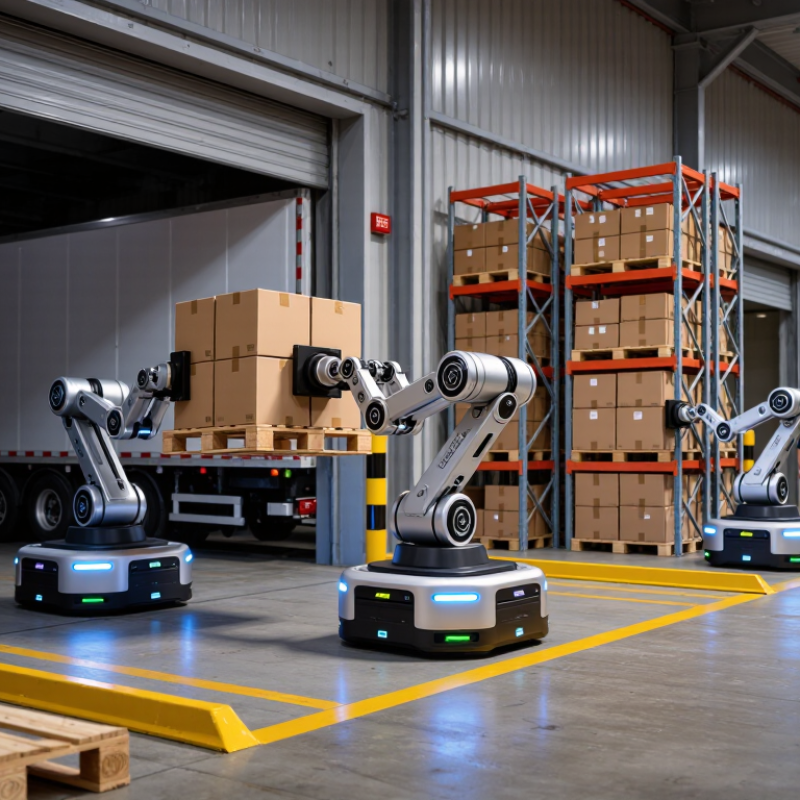
| 1 | Robotic Palletizing and Truck-Loading Cell | High-volume palletized cartons | 80–250 kg per pick, depending on configuration | Approximately 2.5–4.0 m working reach; fixed dock or conveyor interface | Typically 10–25 cases per minute or 20–40 pallet movements per hour | Cartons, bags, shrink-wrapped cases, and standard pallets | Requires a guarded cell, floor anchoring, pallet conveyors, safety scanners, and reliable power and compressed air where applicable | Inspect grippers, robot joints, conveyor chains, sensors, and safety devices; preventive service is commonly scheduled every 3–6 months | Confirm pallet dimensions, electrical standard, language support, safety certification, spare-parts availability, and local integration capability |
| 2 | Telescopic Conveyor with Robotic End Effector | Mixed carton loading into trailers and containers | Usually 15–50 kg per carton | Telescopic extension commonly reaches 10–20 m into a vehicle | Approximately 300–900 cartons per hour, depending on carton size and operator interaction | Corrugated cartons and stable cases with a defined weight range | Needs dock-floor clearance, vehicle alignment control, conveyor anchoring, and integration with upstream sortation | Maintain rollers, belts, telescoping sections, drive motors, photoelectric sensors, and emergency-stop circuits | Check dock dimensions, trailer-height variation, container standards, voltage, customs requirements, and service response time |
| 3 | Autonomous Mobile Robot for Pallet Movement | Point-to-point transport between staging and loading docks | Commonly 600–1,500 kg per vehicle | Flexible navigation over warehouse routes; route length is software-configurable | Often 20–60 pallet moves per hour per unit, depending on travel distance | Standard pallets, roll cages, and pallet boxes with defined footprints | Requires mapped routes, charging stations, floor-condition assessment, network coverage, and traffic-management rules | Check drive wheels, batteries, lidar or camera sensors, charging contacts, and navigation maps; battery replacement is a periodic cost | Verify radio-frequency compliance, warehouse-network security, local safety rules, battery shipping restrictions, and availability of trained technicians |
| 4 | Autonomous Forklift Loading System | Pallet loading in repetitive dock operations | Typically 1,000–2,500 kg per pallet | Suitable for standard warehouse aisles and trailer loading zones; lift height often 2–5 m | Approximately 15–35 pallet moves per hour, subject to travel distance and trailer layout | Standard pallets with known load stability and fork-entry dimensions | Needs accurate pallet locations, level floors, reflective or mapped navigation references, dock controls, and safety zoning | Inspect forks, mast components, tires, batteries, brakes, sensors, and load-detection systems; daily visual checks remain important | Review floor tolerances, pallet standards, local driverless-vehicle regulations, insurance requirements, and operator-training obligations |
| 5 | Robotic Container Unloading and Depalletizing System | High-volume floor-loaded cartons | Usually 10–35 kg per carton | Commonly 2–4 m reach with a telescopic or articulated handling mechanism | Approximately 300–1,000 cartons per hour, depending on carton arrangement and product variation | Uniform cartons with consistent surfaces, dimensions, and weight distribution | Requires a container interface, 3D or vision sensing, carton accumulation conveyors, and controlled access around moving equipment | Clean cameras and suction surfaces, inspect vacuum generators and grippers, recalibrate vision, and check conveyor alignment | Confirm container internal dimensions, ambient temperature range, product variability, vacuum-pump compatibility, and local commissioning support |
| 6 | Collaborative Carton-Loading Robot | Small and medium facilities with changing product mixes | Commonly 5–20 kg per carton | Approximately 1.0–1.7 m arm reach, often extended by a mobile base or conveyor | Typically 150–500 cartons per hour, depending on motion sequence and human collaboration | Cartons, trays, totes, and lightweight cases with predictable gripping surfaces | Usually requires less guarding, but risk assessment, safety scanners, end-effector setup, and stable floor space are still necessary | Check gripper pads, force sensors, joints, cables, software versions, and safety functions; operator cleaning and inspection are essential | Assess permitted collaborative modes, regional machinery regulations, plug-and-play claims, training materials, and remote-support arrangements |
| 7 | Robotic Roll-Cage and Tote Loading System | Retail distribution, parcel consolidation, and reusable containers | Typically 10–80 kg per item or tote | Approximately 1.5–3.0 m reach within a defined cage or tote-loading zone | About 200–700 items per hour, depending on item recognition and stacking pattern | Roll cages, plastic totes, trays, cartons, and reusable transport containers | Needs standardized cage geometry, container-position sensors, barcode or vision systems, and floor space for staging | Clean scanners and cameras, inspect grippers and cage guides, update item databases, and verify stacking-pattern accuracy | Confirm reusable-container dimensions, barcode standards, data-integration protocols, export packaging rules, and availability of replacement tooling |
| 8 | Vacuum-Gripper Case-Loading Robot | Regular cartons with smooth, non-porous surfaces | Approximately 5–40 kg per carton | Typically 1.8–3.0 m reach with conveyor-fed loading | Approximately 400–1,200 picks per hour in stable product conditions | Sealed corrugated cartons, boxes, and selected plastic cases | Requires compressed air or an electric vacuum system, suitable carton surfaces, guarding, and controlled conveyor spacing | Replace or clean suction cups, inspect vacuum lines and filters, monitor leakage, and calibrate pressure sensors | Check compressed-air quality, local utility costs, carton porosity, spare-cup availability, regional electrical requirements, and service expertise |
| 9 | Layer-Pattern Pallet Loading Robot | Bags, cases, and uniform products requiring stable pallet patterns | Commonly 20–150 kg per layer or handling cycle | Approximately 2–4 m reach with pallet positions on one or both sides | Often 15–35 pallet layers per hour, depending on layer size and product weight | Cartons, sacks, cases, drums, and other products with repeatable layer geometry | Needs pattern software, pallet dispensers, slip-sheet handling where required, guarding, and level pallet staging | Inspect layer grippers, pallet magazines, centering devices, sensors, and pattern recipes; lubricate mechanical components according to schedule | Verify product dimensions, pallet standards, maximum vehicle height, stacking regulations, software-language options, and installation lead time |
| 10 | Hybrid Robotic Dock-Loading Platform | Facilities handling pallets, cartons, and variable vehicle types | Approximately 20–250 kg per handling cycle, depending on attachments | Typically 2–5 m operating envelope with conveyor, lift, or mobile-platform extension | Approximately 15–30 pallet movements or 250–800 cartons per hour, depending on selected mode | Mixed loads, cartons, totes, roll cages, and selected pallet formats | Requires detailed site engineering, dock-leveler coordination, safety zoning, traffic control, and integration with warehouse software | Maintain multiple end effectors, lift mechanisms, wheels or tracks, sensors, software interfaces, and safety systems | Use a total-cost-of-ownership review covering integration, import duties, local certification, training, spare parts, cybersecurity, and lifecycle support |